

Artikel: Five fires, five philosophies of grilling

Five fires, five philosophies of grilling
Every grill on the market right now is an argument about how fire should behave. Buy one, and you've picked a side in that argument, whether you meant to or not.
Each system is solving the same problem in a different way: how to turn combustion into flavor. Some solve it with sealed ceramic mass. Some with an adjustable grate hovering over an open flame. Some with an auger and a thermostat doing the thinking for you. What follows is a walk through five grill systems, the kettle, the kamado, the Santa Maria, the hibachi, and the pellet grill, and the physics, history, and use case that define each one.
American grilling is really several traditions stacked on top of each other, each one arriving from a different direction and settling in for good. The kettle came out of postwar Midwest ingenuity. The kamado carried centuries-old Asian ceramic technique into a suburban backyard. The Santa Maria and its Argentine cousin, the parrilla criolla, grew up independently on two continents of cattle country — part of a broader tradition of Argentinian grills that runs from California to the Pampas. The hibachi arrived from Japanese homes that had used it for heat long before anyone grilled on it. The pellet grill is the newest of the five, engineered in the Pacific Northwest for cooks who wanted consistency without giving up smoke.
Not sure where to start? Our beginners guide to grilling lays the groundwork before you pick a system. By the end of this piece, you’ll know which of these five fires actually matches how you cook.
The physics that separates a grill from a grill
Every grill design comes down to five variables, and once you can see them, the difference between a kettle and a kamado stops looking like marketing and starts looking like engineering.
-
The heat source itself: charcoal, wood, gas or pellets. Each burns at a different temperature and releases different volatiles into the food.
-
How the heat reaches your dinner:
-
Radiation is direct energy off glowing coals or an infrared burner.
-
Conduction is contact with a hot surface, the same principle behind a griddle vs grill comparison.
-
Convection is heated air circulating around the food inside a closed lid. Most grills blend two of the three, and the ratio is what makes one grill feel completely different from another even when both are burning the same charcoal.
-
Temperature control: airflow vents on a kettle or kamado, physical grate height on a Santa Maria, or electronics running the show on a pellet grill.
-
Geometry, open versus closed. Open grills feed the fire oxygen and lose heat fast. Closed grills recirculate heat and hold moisture, but they also starve the fire of the air it needs to burn hot. This one variable changes almost everything downstream of it.
-
Thermal mass. Thin steel, like a kettle's bowl, heats up fast and cools down just as fast. Thick ceramic, like a kamado's walls, takes the better part of an hour to warm up and then holds that heat for most of a day. Cast iron sits in between. Once you can place a grill on these five axes, the styles below stop being five separate purchases and start looking like five answers to the same equation.
The kettle: America's default fire
The kettle grill exists because of a buoy. George Stephen Sr. worked at Weber Brothers Metal Works outside Chicago in the early 1950s, and he was tired of his open brazier flaring up and losing heat to the wind. He cut a metal buoy in half, welded on legs and a lid, and built the first covered charcoal grill most backyards had ever seen. The story is well documented, down to the neighbors who thought he'd lost his mind.
The design is almost embarrassingly simple: a hemispherical bowl, a domed lid, a charcoal grate at the bottom, a cooking grate above, and vents top and bottom that let you dial airflow up or down. Close the lid and you get indirect convection cooking. Open it and you get direct radiant heat. That single piece of engineering is what separates a kettle from the open braziers that came before it.
The trade-off shows up the moment you want more than one thing from your fire at once. There's no way to raise or lower the food relative to the coals, so adjusting heat means physically moving charcoal around or fighting with vents. Fuel capacity is limited too, which caps how long you can hold a low, steady smoke. What the kettle does extremely well is everything a weekend cookout actually needs: burgers, chicken, casual grilling that doesn't demand restaurant-level searing or a fourteen-hour brisket. Check the following article to discover how charcoal itself behaves inside a grill like this, from lump to briquettes.
The kettle's genius and its ceiling are the same thing: it does very little, and it does it for almost anyone. If you want a step up in fire control and craftsmanship, see our Gaucho grills — built for cooks who want more from open fire.

The kamado: ceramic mass, infinite patience
The kamado's lineage goes back further than any other grill on this list, to clay cooking vessels used across East Asia for centuries. The version that shows up in American backyards today is a postwar invention. Ed Fisher started importing Japanese kamados into Atlanta in the mid-1970s, and Big Green Egg grew out of that import business into the ceramic grill brand most people picture when they hear the word "kamado."
The kamado has a lineage that goes back centuries. The whole design premise is thermal storage rather than combustion. Thick ceramic walls, often over an inch, hold an enormous amount of heat and radiate it evenly back at the food. A heavy hinged lid with a gasket seals the system almost completely, so the fire burns on very little oxygen and stretches a single load of lump charcoal across many hours at low temperature.
That sealed system comes at a cost. A kamado takes roughly 20 to 45 minutes just to stabilize at temperature, a large one can weigh over 200 pounds, and the price tag reflects both the ceramic and the engineering. In exchange you get the most versatile grill of the five: long cooks like brisket and pork shoulder, whole roasted birds, high-heat pizza, even cold smoking. For a head-to-head on heat source trade-offs, read our smoker vs grill comparison. What it can’t replicate is the open-flame character of a Santa Maria or the compact intensity of a hibachi. It’s built for cooks who want one appliance that does nearly everything, and who don’t mind waiting for it to get there.

The Santa Maria grill: California meets the Pampas
This is the grill we know best, because it's the one we build.
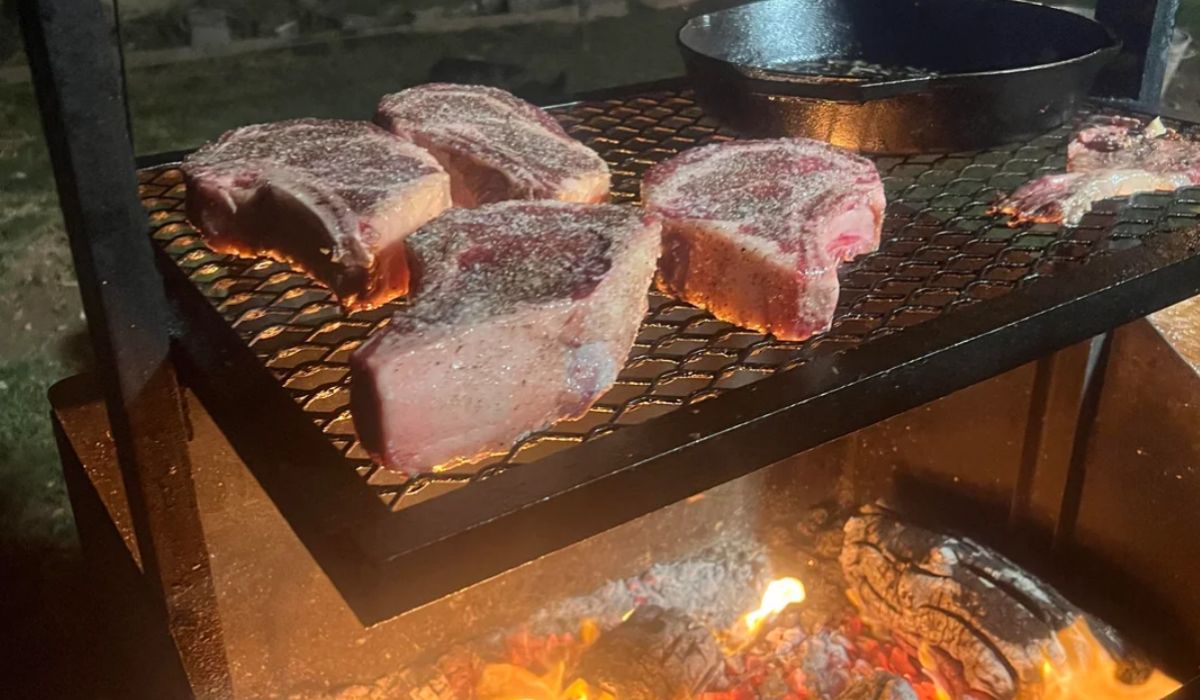
The Santa Maria style comes out of Central California’s ranching country, where cooks developed a way to grill beef over open oak fires that eventually hardened into a regional tradition. Independently, on the other side of the equator, Argentine ranchers arrived at almost the same solution with the parrilla criolla. Different continents, different centuries, the same core idea: an open firebox, a solid grate, and a crank or wheel that raises and lowers that grate over the coals. Most Santa Maria and Argentine grills also include an Argentine Brasero, a side firebox for producing fresh embers. Our Argentine Santa Maria Grill pairs with Santa Maria Grill V Grates for a complete open-fire setup.
Height control is the entire innovation here. Move the grate closer to the coals and you get a hard sear driven by the Maillard reaction. Move it away and the same fire becomes gentle enough for a whole chicken. Because the geometry is open, smoke passes over the food instead of recirculating around it, which is why Santa Maria and Argentine-style beef doesn't taste like American barbecue. It's a cleaner flavor axis, built around the meat rather than around infused smoke. If you want to see the full range we build around this system, our Santa Maria grill collection is where we put everything that setup can do.
None of this comes for free. A Santa Maria grill rewards someone who understands fire management and punishes anyone hoping to walk away for twenty minutes. Curious how it stacks up against the other great American wood-fire tradition? Read our santa maria vs texas style barbecue breakdown. It’s built for steaks, tri-tip, whole cuts, asado-style cooks that run for hours. It’s a poor match for a weeknight burger or anyone who wants to set a dial and leave.

The hibachi: Japan's small fire, big flavor
The hibachi, 火鉢, literally translates to "fire bowl," and for most of its thousand-year history in Japan it heated rooms rather than food. Its move into cooking is more recent, tied to the yakitori stalls and izakaya bars where small charcoal grills became the standard tool for skewers. In the West, the word has drifted to mean almost any small Japanese-style charcoal grill, which creates one very common mix-up.
The design is a small rectangular vessel, usually cast iron, sitting on a firebrick or ceramic refractory base with an open top and bottom-vented airflow. That firebrick base is the real technical trick: it reflects radiant heat back up at the grate, letting a grill this small reach temperatures a same-sized sheet of thin metal could never sustain. Food sits just two to four inches above the coals, which is why hibachi cooking produces such fast, hard charring and such an intense charcoal note.
Most American readers know the word "hibachi" from steakhouse dinners, and that's not the grill we're describing here. What gets served at most Japanese steakhouses in the US is teppanyaki, a large flat gas griddle that Benihana popularized decades ago. Real hibachi is small, fueled by charcoal, and built for skewers, whole fish, and small cuts, not a chef doing knife tricks on a flat top.
This is where our own catalog stops and our sister workshop's begins. At japanese bbq grill, our sister workshop in Buenos Aires, we build handcrafted hibachi grills using the same cast iron and firebrick construction that defines the traditional Japanese design, testing every unit before it ships. It's a small cooking surface, a full-size hibachi still only feeds three to five people, and it demands active charcoal management with no lid for indirect cooking. What it gives back is precision: yakitori, whole fish, hibachi-style steak, done with a level of char no larger grill can match.

The pellet grill: algorithms meet wood smoke
The pellet grill is the youngest system here by a wide margin. Joe Traeger built the first prototype in Oregon in 1985, patented the design in 1986 and 1987, and held the category to himself for two decades before the patent expired and competitors flooded in.
A hopper holds wood pellets, an auger feeds them into a firebox, an electric igniter starts the burn, and a thermostat paired with a temperature probe controls pellet flow to hold whatever setpoint you dial in. You set a target temperature and the electronics manage the rest, which is the entire appeal.
The result is almost pure convection with a light layer of smoke flavor, and remarkably steady heat over long stretches, which is exactly why pellet grills have become the default tool for backyard smoking. The trade-offs are real: most pellet grills rarely clear 500°F, so they can't sear the way charcoal or an open flame can, they need electricity to run at all, and the flavor is more restrained than what you get off live embers on a Santa Maria or a hibachi. They're built for low-and-slow, for a roast turkey, for anything where holding a steady temperature matters more than a hard sear. For a full comparison with live fire, read our pellet grill vs charcoal grill.

Frequently asked questions
What are the three main types of grilling?
Direct heat, indirect heat, and smoking. Direct heat puts food right over the fire, the method behind a good steak or burger sear. Indirect heat separates fire and food, usually behind a closed lid, and handles larger cuts and roasts. Smoking runs low temperatures for hours, using wood smoke to build flavor gradually. Most grills handle one or two of these well. Few handle all three.
What's the best grill for someone just starting out?
For most people, a kettle. It's affordable, forgiving, and available at every hardware store in the country. Light the charcoal, wait for it to grey, and cook. Once fire management feels automatic, moving up to a kamado or a Santa Maria makes a lot more sense.
Do serious cooks really need more than one grill?
Often, yes. A Santa Maria delivers open-fire steak better than any kamado on the market, but a kamado will outlast it on a fourteen-hour brisket. A pellet grill holds 225°F all night without complaint, but it will never sear a hibachi steak the way real charcoal does. Most committed home cooks end up with at least two setups: one for high-heat direct grilling, one for low-and-slow.
What's the difference between a hibachi and a kamado?
They solve opposite problems. The hibachi is small, open, and built for short, intense cooks — skewers and small cuts over close coals. The kamado is large, sealed, and built for long duration at low, steady heat. One is a tool for precision. The other is a tool for patience. For a deeper look at the hibachi tradition — its history, design, and what separates it from everything else on this list — our friends at Fuku Labs cover what is hibachi in full.
Which grill sears the hardest?
For pure peak temperature at the grate, a well-managed Santa Maria with the grate close to fresh embers, or a cast-iron hibachi burning binchotan, will out-sear almost anything on this list, well beyond what a home gas grill or a pellet grill can reach. That's the reason cooks who care about the crust invest in open-flame or radiant-heat systems instead of electronics.
Which fire is yours
Five grills, five different relationships with fire. The kettle is forgiving. The kamado is patient. The Santa Maria rewards skill. The hibachi rewards precision. The pellet grill trades some of that character for convenience. None of them wins outright, and anyone telling you otherwise is selling something.
What matters is figuring out which negotiation between physics and technique actually fits how you cook. We build our Santa Maria and Argentine-style grills for the cook who wants the fire in their own hands. Browse our gaucho grills or explore the full range of argentine grills to find the setup that fits.
Because at Gaucho Life, we know it is more than just grilling. It’s a lifestyle.

Read more
Griddle vs. Grill: Mastering Argentine Asado Thermodynamics
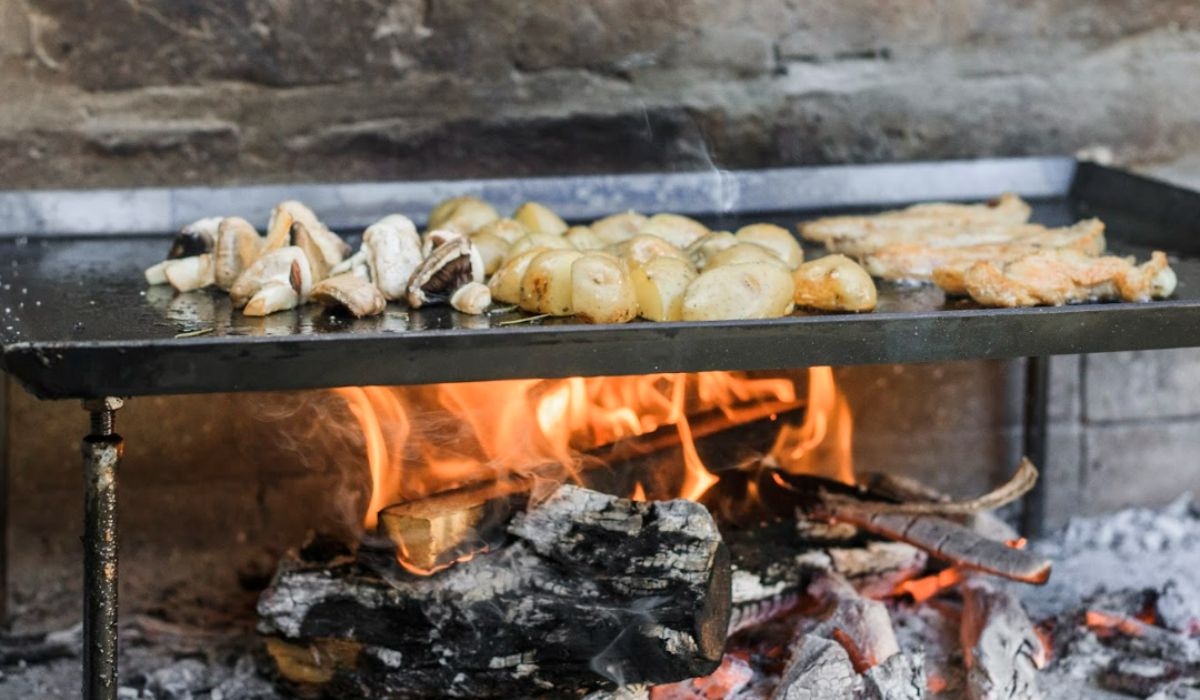
The choice between an argentine griddle and a gaucho grill is rarely as simple as it looks. At its core, it's a question of thermodynamics: how heat moves, how it interacts with protein and fat, an...
Weiterlesen
Hinterlasse einen Kommentar
Diese Website ist durch hCaptcha geschützt und es gelten die allgemeinen Geschäftsbedingungen und Datenschutzbestimmungen von hCaptcha.